Showing posts with label Bonding. Show all posts

Monday, May 9, 2016

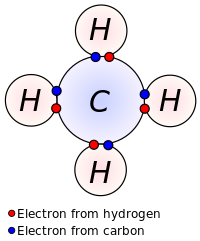
Electron dot formulas of molecules

Here are the guidelines to placing electron dot diagrams of molecules

  1. calculate the total number of valence electrons by adding all of the valence electrons for each atom in the molecule
  2. divide the total valence electrons by 2 to find the number of electron pairs in the molecule
  3. surround the central atom with 4 electron pair. use the remaining electron pairs to complete the octet around the other atoms
  4. electron pairs that are shared by atoms are called bonding electrons. the other electrons complete octets and are called non bonding electrons, or lone pairs
  5. if there are not enough electron pairs to provide each atom with an octet, move a non bonding electron pair between two atoms that already share an electron pair.

Covalent Bonds and Bond energy

Covalent bonds are a result of the sharing of the electrons of two nonmetal atoms. Both atoms involved in the bond share electrons to fill their particular octet. Each atom brings to the bond, the number of valence electrons and when the two combine, the octet is satisfied.


https://en.wikipedia.org/wiki/Covalent_bond

Energy is released when two ions are attracted to one another and form an ionic bond. when a bond is broken, it takes energy to do so. The energy required to break a bond is called bond energy. The amount of energy needed to form a bond is identical to the energy needed to break the bond.


http://www.science.uwaterloo.ca/~cchieh/cact/c120/bondel.html

here are some helpful websites
http://chemwiki.ucdavis.edu/Core/Theoretical_Chemistry/Chemical_Bonding/General_Principles_of_Chemical_Bonding/Bond_Energies

https://en.wikipedia.org/wiki/Bond_energy

http://chemed.chem.purdue.edu/genchem/topicreview/bp/ch8/valenceframe.html

Octet rule

In atoms there are two distinct electron regions: outer shell electrons found in the s adn p blocks, and inner electrons. The octet rule will determine how many electrons are to be placed in the valence shell. This rule states that no atom can have more than 8 electrons total in the outer shell. these electrons can be shared or given over to another atoms outer shell.


https://www.youtube.com/watch?v=WzWk-mx_14E


http://chemistrytextbookcrawl.blogspot.com/2012/07/inorganic-chemistry-shriver-and-atkins_31.html

Here are some helpful sites on the rule
https://en.wikipedia.org/wiki/Octet_rule

http://chemwiki.ucdavis.edu/Core/Inorganic_Chemistry/Electronic_Structure_of_Atoms_and_Molecules/Electronic_Configurations/The_Octet_Rule

http://study.com/academy/lesson/understanding-ions-and-drawing-lewis-structures.html