Showing posts with label Chemical reactions. Show all posts

Thursday, December 3, 2015

Redox reactions

An redox reaction (oxidation-reduction) is a type of chemical reaction that involves a transfer of electrons between two substances. An redox reaction is any chemical reaction in which the oxidation number of a molecule, atom, or ion changes by gaining or loosing an electron. This is the driving force of these reactions. Based on weather a substance looses or gains electrons tells you if it is the oxidizing agent, or reducing agent. To tell if the substance looses or gains electrons we use these oxidation number rules.

http://www.slideshare.net/smartensen/51-b-groups-oxidation-states

If you want more help with these reaction you can visit these sites
http://chemwiki.ucdavis.edu/Analytical_Chemistry/Electrochemistry/Redox_Chemistry/Oxidation-Reduction_Reactions

https://www.khanacademy.org/science/chemistry/oxidation-reduction/redox-oxidation-reduction/v/oxidizing-and-reducing-agents-1

Acid base reactions

In acid base reactions the driving force is the production of water. These reactions form a salt and water as products. A salt can be described as a cation or base and anion of an acid. Some things that affect these reactions are the strength of the acid and base. Strong acids produce hydrogen, and their oxygen's outnumber the hydrogen's by two or more. A strong base would contain -OH, disassociate completely, and are contain group 1 and 2 metals plus the -OH.

Here are some links for some examples and practice
https://www.khanacademy.org/science/chemistry/oxidation-reduction/redox-oxidation-reduction/v/oxidizing-and-reducing-agents-1

http://www.britannica.com/science/acid-base-reaction

Wednesday, December 2, 2015

Precipitation Reactions

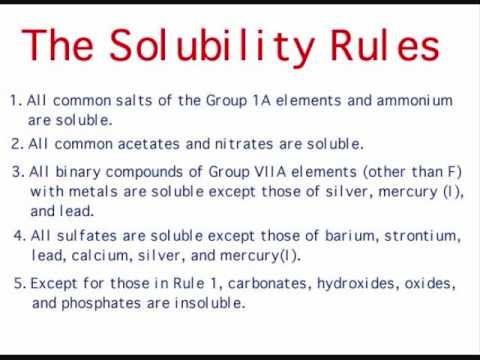
Precipitation reactions is the formation of a solid salt when two solutions containing soluble salts are combined. Whether or not a reaction occurs can be determined using the solubility rules for ionic solids. Because not all reactions form a precipitate, you have to use the solubility rules to tell if the substance created is a insoluble salt.


https://www.youtube.com/watch?v=WPnrMTCK0aU

 When looking at these reactions they can be seen in the molecular equation, complete equation, and net ionic equation as it goes through the reaction.

http://www.slideshare.net/colinquinton/04-3144335


If you want to know more about precipitation reactions you can visit these sites
http://chemwiki.ucdavis.edu/Inorganic_Chemistry/Reactions_in_Aqueous_Solutions/Precipitation_Reactions

https://www.youtube.com/watch?v=IIu16dy3ThI

Sunday, November 22, 2015

Solubility lab

In this lab we combined drops from different chemicals in a well plate and looked to see if any precipitate formed. First we gathered all of the reagents in pipettes. We then used our chart to see which of the reagents that we would be combining. When we combined the substances if no precipitate formed we put a dash through the box, but if a precipitate formed we placed its formula in the box.


Basics of chemical reactions

Chemical reactions are reactions that are usually characterized by a chemical change, and they yield one or more products. Some of the clues that a chemical reaction has occurred are color change, solid forms, bubbles form, and heat or a flame is produced. The substance or substances,  initially involved in a chemical reaction are called the reactants. What the chemical reaction yields is called a product.

Here are some examples of chemical reactions

https://en.wikipedia.org/wiki/Combustion
Image result for chemical reactions examples
http://www.grandinetti.org/chemical-reactions